Chlorine Position in Periodic Table, Occurrence, Preparation, Reaction and Uses Example
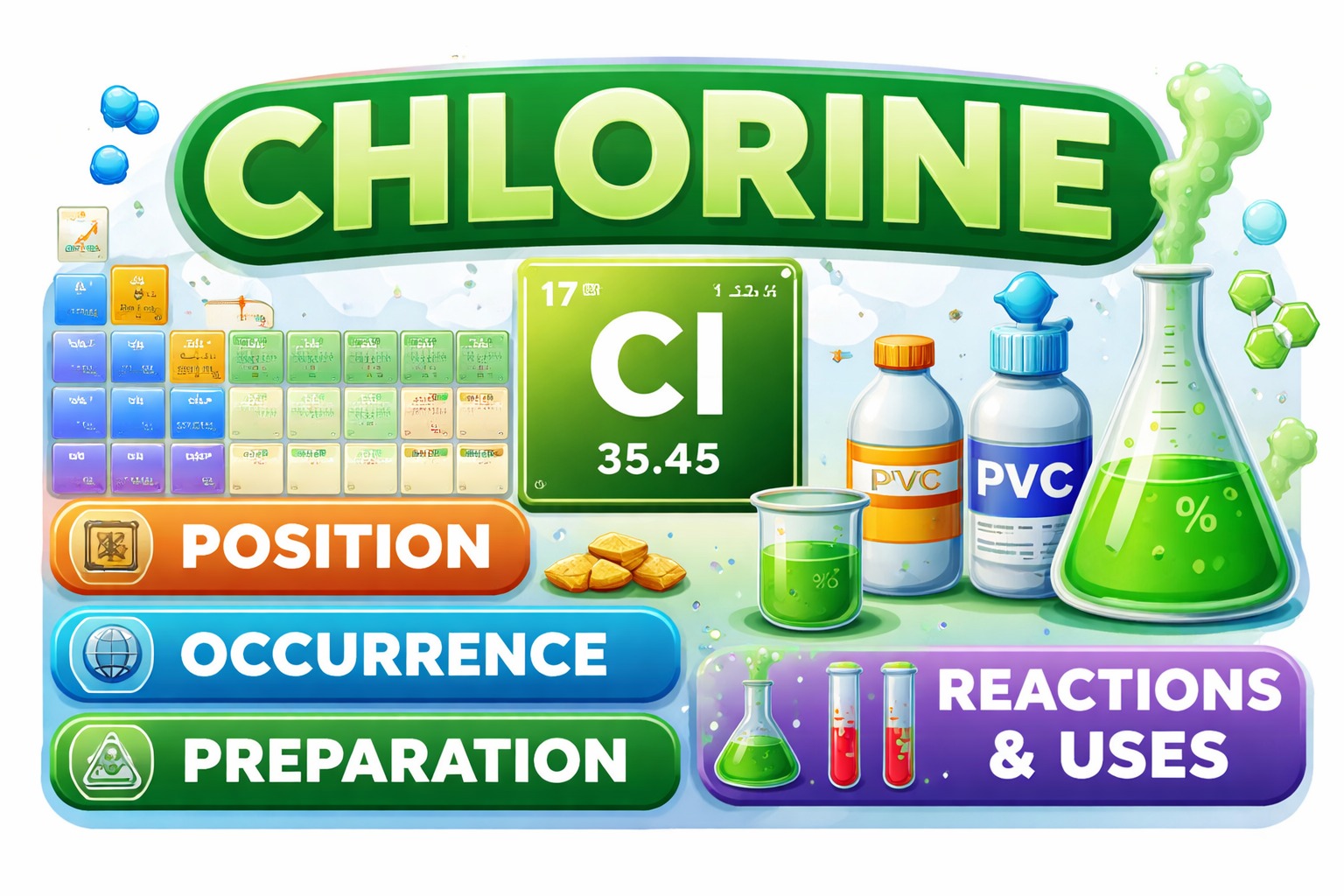
Chlorine (Cl)
| Symbol | Cl |
| Atomic Number | 17 |
| Oxidation States | -1,+1,+3,+5,+7 |
| Electronic Configuration | 1s² 2s² 2p6 3s2 3p5 |
| Atomic Mass | 35.5 |
POSITION IN PREODIC TABLE
| Group | Group 17 (Halogen Group) |
| Periods | Period 3 |
| Block | p-block |
Ores of Chlorine
Chorine is not found in a free state in nature. It mainly occurs in the combined From as Salt NaCl (Sea Water), KCl Sylvite and Carnallite (KCl.MgCl2.6H2O). Sea water contains a Large amount of Chlorine in the form of Chlorides.
Why Chlorine is Found as Compound
Chlorine is very reactive, so it easily combines with metals and non-metals. That is why it is never found in pure from in nature.
Methods of Preparation Of Chlorine
(1) Chlorine gas is preared in the laboratory by the oxidation of Hydrochloric Acid (HCl) using Manganese dioxide (MnO2 )
MnO2 + 4HCl → MnCl2 + 2H2O + Cl2↑
in this reaction, manganese dioxide acts as an oxidizing agent and converts hydrochloric acid in to chlorine gas.
(2) Oxidation of Hydrochloric Acid By Potassium Dichromate
Chlorine gas can also be prepared in the laboratory by oxidizing Conc. hydrochloric(HCl) acid with potassium dichromate(K2Cr2O7)
K2Cr2O7 + 14HCl → 2KCl + 2CrCl3 + 7H2O + 3Cl2↑
(3) Action of Dilute Acid on Bleaching Powder
When dilute Sulphuric acid reacts with Bleaching Powder to form Chlorine gas is released.
Ca(OCl)Cl + H2SO4 →CaSO4 + H2O + Cl2↑
When dilute Hydrochloric Acid (HCl) reacts with Bleaching Powder to form Chlorine gas is released.
Ca(OCl)Cl + 2HCl → CaCl2 + H2O + Cl2↑
(4) Oxidation Of Hydrochloric Acid (HCl) by Red Lead (Pb3O4)
Red Lead Oxidised Hydrochloric Acid (HCl) to produce Chlorine gas.
Pb3O4 + 8HCl 3PbCl2 + 4H2O + Cl2↑
Chemical Reaction Of Chlorine
Uses OF Chlorine
Production of Hydrochloric Acid (HCl)
for Bleaching Clothes and paper.
For Purification and Drinking water because it acts as a disinfectant
For Extraction of Gold
For the Production Of chloroform





Post Comment