Class 10 Science One-Liner Question Answers | Physics Chemistry Biology Exam Revision
Class 10 Science One-Liner Question Answers are very useful for quick exam revision. This post includes Chemistry, Biology and Physics one-liners in simple Language. These are specially designed for CBSE and Board Exams Class 10 students to revise important concepts before exams. All questions are short, clear and Exam Orientation, perfect for last-minute preparation
CHEMISTRY
A chemical reaction forms a new substance.
In a balanced chemical equation, the number of atoms is equal on both sides.
Oxidation is the gain of oxygen.
Reduction is the loss of oxygen.
Rusting occurs due to oxygen and moisture.
An acid releases H⁺ ions in solution.
A base releases OH⁻ ions in solution.
A solution with pH less than 7 is acidic.
A solution with pH more than 7 is basic.
A neutral solution has pH 7.
Washing soda is Na₂CO₃·10H₂O.
Baking soda is NaHCO₃.
Limestone is calcium carbonate.
Corrosion weakens metals.
Galvanization prevents rusting of iron.
Ethanol has the formula C₂H₅OH.
Hard water contains calcium and magnesium ions.
Soap does not lather well in hard water.
Detergents work well in hard water.
Alloys are stronger than pure metals.
Q: What is an acid?
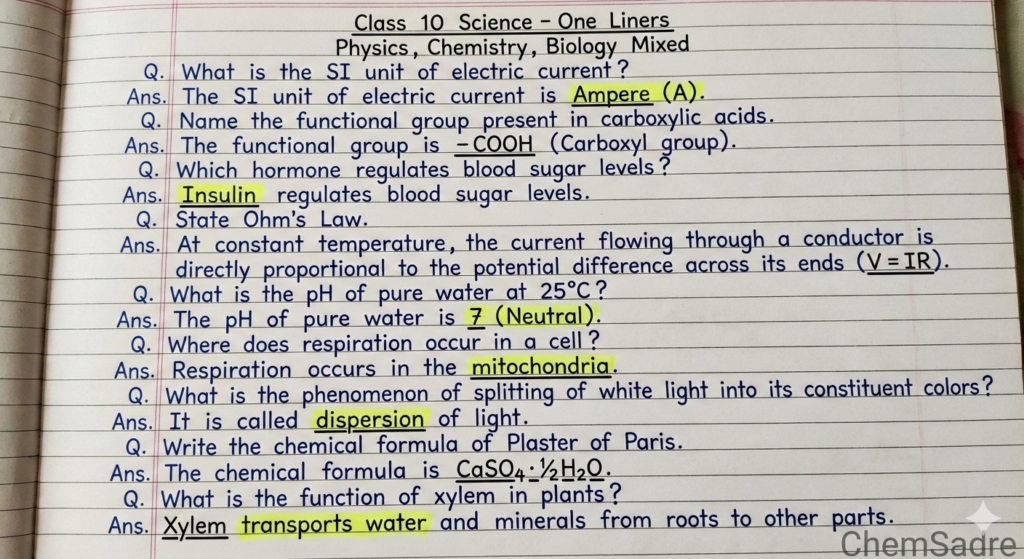
A: An acid produces H⁺ ions in aqueous solution.
Q: What is a base?
A: A base produces OH⁻ ions in aqueous solution.
Q: What is a salt?
A: A salt is formed by the neutralization of an acid and a base.
Q: What is the pH of a neutral solution?
A: 7.
Q: What does pH measure?
A: It measures the acidity or basicity of a solution.
Q: Which acid is present in lemon?
A: Citric acid.
Q: Which acid is present in vinegar?
A: Acetic acid.
Q: Which base is used in making soap?
A: Sodium hydroxide.
Q: What gas is released when an acid reacts with a metal?
A: Hydrogen gas.
Q: What is formed when an acid reacts with a base?
A: Salt and water.
Q: Which substance turns blue litmus red?
A: Acid.
Q: Which substance turns red litmus blue?
A: Base.
Q: What is the chemical formula of common salt?
A: NaCl.
Q: What is the chemical name of baking soda?
A: Sodium hydrogen carbonate.
Q: What is the chemical name of washing soda?
A: Sodium carbonate.
Q: What is the nature of a solution with pH less than 7?
A: Acidic.
Q: What is the nature of a solution with pH more than 7?
A: Basic.
Q: Which indicator is used to measure pH?
A: Universal indicator.
Q: Which salt is used to treat indigestion?
A: Baking soda.
Q: What is plaster of Paris made from?
A: Calcium sulphate hemihydrate.
Q: Why should acids be diluted before use?
A: To reduce their corrosive effect.
Q: What happens when acids are mixed with water?
A: Heat is produced.
Q: Which gas is released when an acid reacts with a carbonate?
A: Carbon dioxide.
Q: What is the pH of a basic solution?
A: Greater than 7.
Q: Why are strong acids harmful?
A: Because they are highly corrosive.
BIOLOGY
Life processes include nutrition, respiration, transportation and excretion.
Photosynthesis occurs in leaves.
Chlorophyll is a green pigment.
Sunlight is essential for photosynthesis.
The human heart has four chambers.
Haemoglobin gives red colour to blood.
Red blood cells carry oxygen.
White blood cells protect the body from diseases.
Platelets help in blood clotting.
Aerobic respiration releases more energy.
Anaerobic respiration releases less energy.
Lungs are the main organs of respiration.
Transpiration occurs through stomata.
Excretion removes waste materials from the body.
Kidney is the main excretory organ.
Nephron is the functional unit of kidney.
Hormones are chemical messengers.
Insulin controls blood sugar level.
Brain controls coordination and activities.
Reflex action is a quick response.
Life processes are activities necessary to maintain life.
Nutrition is the process of obtaining food.
Autotrophic nutrition occurs in green plants.
Heterotrophic nutrition depends on other organisms.
Photosynthesis occurs in chloroplasts.
Chlorophyll traps sunlight for photosynthesis.
Carbon dioxide enters leaves through stomata.
Oxygen is released during photosynthesis.
Respiration releases energy from food.
Aerobic respiration requires oxygen.
Anaerobic respiration occurs without oxygen.
Lungs are the main respiratory organs in humans.
The heart pumps blood throughout the body.
Human heart has four chambers.
Arteries carry blood away from the heart.
Veins carry blood towards the heart.
Blood transports oxygen, food and wastes.
Transpiration is the loss of water from leaves.
Kidney is the main excretory organ.
Nephron is the functional unit of kidney.
Nervous system controls body activities.
Brain is the control centre of the body.
Spinal cord controls reflex actions.
Reflex action is a quick response.
Hormones are chemical messengers.
Endocrine glands secrete hormones.
Insulin controls blood sugar level.
Thyroxine controls metabolism.
Adrenaline prepares body for emergencies.
Coordination helps the body work properly.
Reproduction is the process of producing new individuals.
Asexual reproduction involves one parent.
Binary fission occurs in Amoeba.
Budding occurs in yeast.
Sexual reproduction involves two parents.
Male reproductive organ is testis.
Female reproductive organ is ovary.
Pollination is transfer of pollen grains.
Fertilization forms a zygote.
Human reproduction is sexual reproduction.
Ecosystem is interaction of living and non-living things.
Producers make their own food.
Consumers depend on producers.
Decomposers break down dead matter.
Food chain shows energy flow.
Energy decreases at each trophic level.
Biodegradable wastes can decompose.
Non-biodegradable wastes do not decompose.
Water pollution harms aquatic life.
Deforestation causes soil erosion.
Heredity is transfer of traits from parents to offspring.
Gene is a unit of heredity.
DNA carries genetic information.
Traits are controlled by genes.
Dominant trait is expressed in hybrid.
Recessive trait is hidden in hybrid.
Variation helps in survival of species.
Evolution is gradual change in organisms.
Acquired traits are not inherited.
Mendel is known as father of genetics.
Health is a state of physical and mental well-being.
Communicable diseases spread from person to person.
Non-communicable diseases do not spread.
Vaccination prevents diseases.
Antibiotics kill bacteria.
Virus causes diseases like flu.
Malaria is caused by Plasmodium.
AIDS is caused by HIV.
Balanced diet maintains good health.
Exercise keeps the body fit.
RBC carries oxygen.
WBC fights diseases.
Platelets help in blood clotting.
Xylem transports water in plants.
Phloem transports food in plants.
PHYSICS
Motion is the change in position with time.
Speed is distance travelled per unit time.
Velocity is speed with direction.
Acceleration is the rate of change of velocity.
Force can change the state of motion.
The SI unit of force is Newton.
Work is done when force causes displacement.
The SI unit of work is Joule.
Power is work done per unit time.
The SI unit of power is Watt.
The SI unit of electric current is Ampere.
Resistance opposes the flow of current.
Ohm’s law is V = IR.
Electric power is given by V × I.
Fuse is a safety device.
A magnetic field exists around a magnet.
A convex lens is a converging lens.
A concave lens is a diverging lens.
Image is formed on the retina of the human eye.
Motion is the change in position of an object with time.
Distance is the total path covered by an object.
Displacement is the shortest distance between initial and final position.
Speed is distance travelled per unit time.
Velocity is speed in a given direction.
Acceleration is the rate of change of velocity.
Uniform motion means equal distances in equal intervals of time.
Non-uniform motion means unequal distances in equal intervals of time.
The SI unit of distance is metre.
The SI unit of speed is m/s.
The SI unit of acceleration is m/s².
Force can change the shape of an object.
Force can change the state of motion of an object.
The SI unit of force is Newton.
Newton’s first law is the law of inertia.
Inertia is the resistance to change in motion.
Momentum is the product of mass and velocity.
The SI unit of momentum is kg m/s.
Newton’s second law relates force with momentum.
Newton’s third law states that every action has an equal and opposite reaction.
Work is done when force causes displacement.
The SI unit of work is Joule.
Energy is the capacity to do work.
The SI unit of energy is Joule.
Kinetic energy is energy due to motion.
Potential energy is energy due to position.
Mechanical energy is the sum of kinetic and potential energy.
Power is the rate of doing work.
The SI unit of power is Watt.
Commercial unit of electrical energy is kilowatt-hour.
Electric current is the flow of electric charge.
The SI unit of electric current is Ampere.
Voltage is the potential difference between two points.
The SI unit of voltage is Volt.
Resistance opposes the flow of current.
The SI unit of resistance is Ohm.
Electric power is given by P = VI.
A fuse is a safety device.
Magnetic field exists around a magnet.
Reflection of light follows laws of reflection.
A concave mirror can form a real image.
A convex mirror always forms a virtual image.
A convex lens is a converging lens.
A concave lens is a diverging lens.
Refraction is the bending of light.
The human eye forms image on the retina.
The pupil controls the amount of light entering the eye.
Myopia is short-sightedness.
Hypermetropia is long-sightedness.




1 comment