Ohm’s Law Definition, Verification with Diagram (Class 10 and 12)
Introduction
Ohm’s Law is one of the most fundamental laws of electricity. It explains the relationship between electric current, voltage, and resistance in an electric circuit. This law is very important for students of Class 10th as it forms the base of understanding electrical circuits and devices.
Ohm’s Law was given by German scientist Georg Simon Ohm (1826)
Statement of Ohm’s Law
At constant temperature, the electric current flowing through a conductor is directly proportional to the potential difference applied across its ends.
According to this law, if the physical conditions of a conductor (such as temperature) remain constant, the electric current flowing through it is directly proportional to the potential difference applied across its ends.
Mathematical Form of Ohm’s Law
(V ∝ I)
Or, [V = IR]
[Where V = Potential difference (Volt) I = Electric current (Ampere)R = Resistance (Ohm)]
Verification of Ohm’s Law
Electric circuit for the verification of Ohm’s Law
Explanation- Ammeter is connected in series to measure current. Voltmeter is connected in parallel across the resistor. Key is used to switch the circuit ON or OFF
Apparatus Required -Battery, Plug key, Ammeter, Voltmeter, Rheostat, Connecting wires, Resistor.
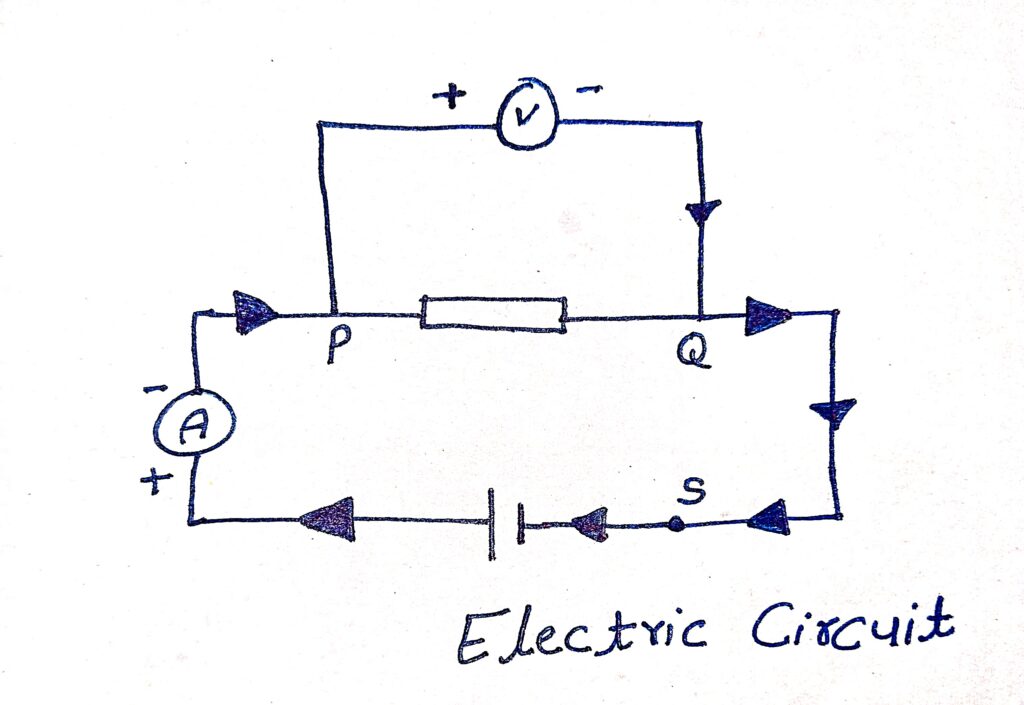
On closing the switch S, current starts flowing in the circuit. The ammeter measures the current (I) flowing through the circuit, and the voltmeter measures the potential difference (V) across the ends of the nichrome wire. Now, by using two cells instead of one, we again note the readings of the ammeter and voltmeter. We repeat this process by connecting more cells in the circuit. In this way, we find that the value of the ratio V/I remains almost the same every time.
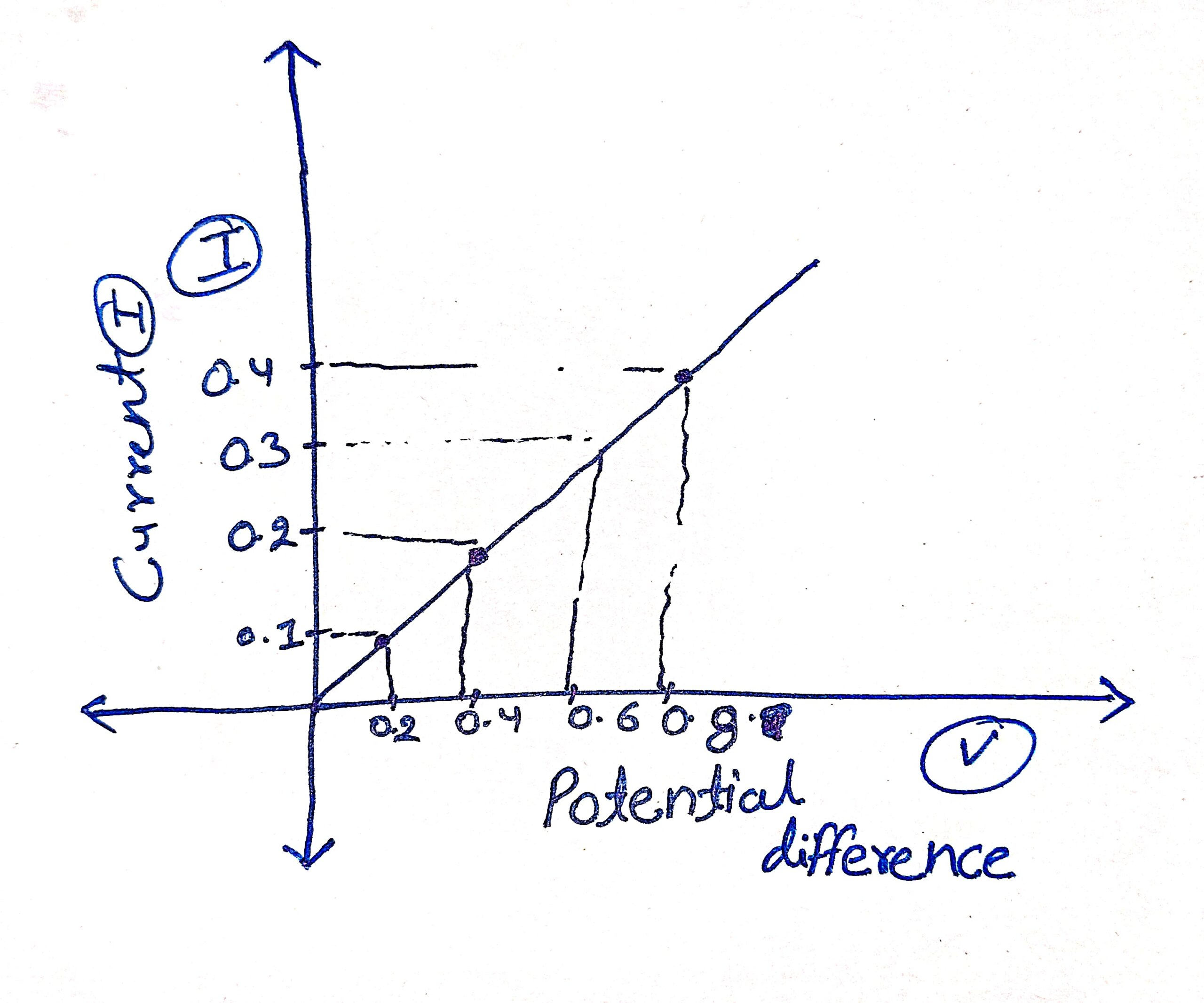
Verification of the law through a graph
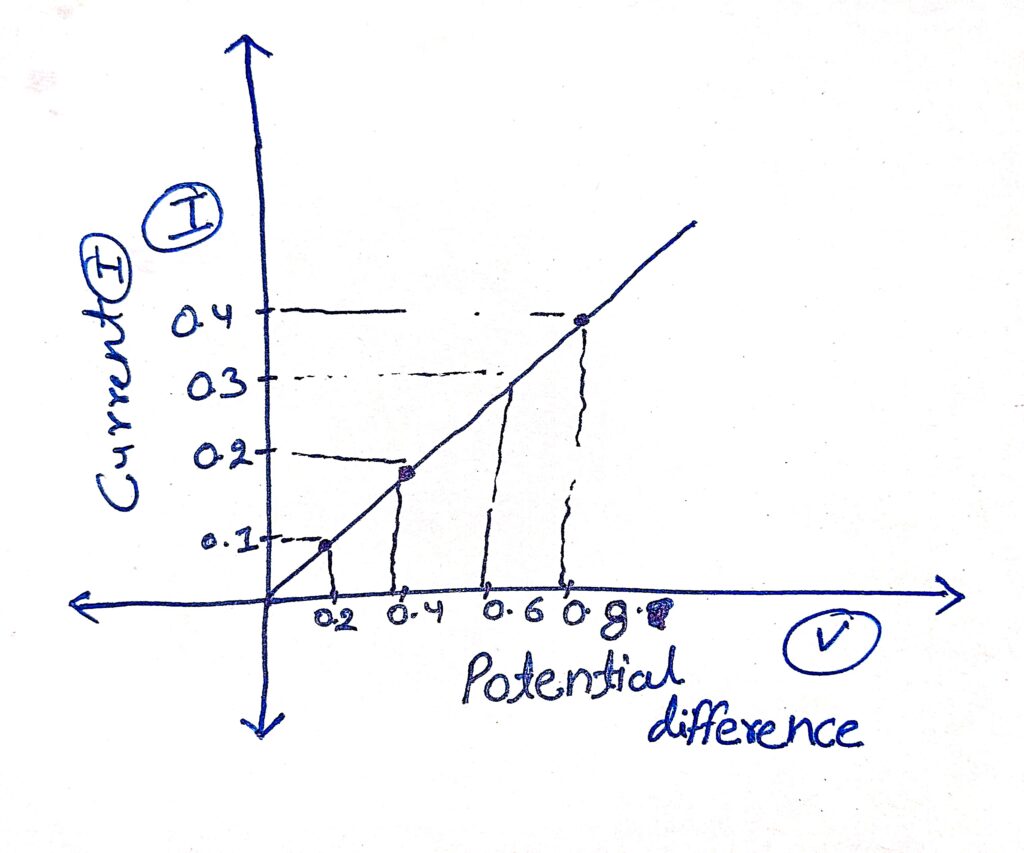
If a graph is drawn between the potential difference (V) and the current (I), taking the potential difference on one axis and the current on the y-axis, the resulting graph is a straight line. This proves that the electric current (I) is directly proportional to the potential difference (V)
Observation Table
| S. No. | Voltage (V) | Current (I) | V/I (Ω) |
| 1 | 2 | 0.2 | 10 |
| 2 | 4 | 0.4 | 10 |
| 3 | 6 | 0.6 | 10 |
Result
From the observation table, the ratio V/I remains constant. This constant value is the resistance of the conductor.
Limitations of Ohm’s Law
Ohm’s Law is not valid at very high temperatures.
It does not apply to semiconductors like diodes and transistors.
It is not applicable to gaseous conductors.
Conclusion Ohm’s Law helps us understand how electric current behaves in a circuit. It is widely used in electrical engineering and physics. The verification of Ohm’s Law proves that voltage and current are directly proportional under constant physical conditions








1 comment